Hey guys, let’s cut to the chase—if you’re scrolling for backyard upgrades, artificial turf’s probably popped up more times than your delivery app notifications. But I get it, the big question that stops so many folks from pulling the trigger is: Is backyard artificial turf slippery when it gets wet? As someone who’s been in the artificial turf supply game for years, I’ve heard every take—from “I slipped on my neighbor’s once and sprained my ankle” to “Nah, it’s way better than natural grass when it rains.” Today, I’m gonna break this down like I would with a client who just called me at 7 a.m. panicking about their kid’s birthday party, no fancy jargon, just real talk and actual science. Backyard Artificial Turf
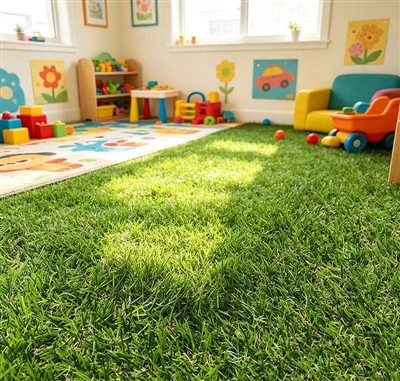
First off, let’s kill the myth that all artificial turf is the same. I’ve seen cheap turf from big-box stores that turns into a slip hazard when it rains, and I’ve installed premium stuff that’s grippier than a basketball court on a rainy day. The difference? It all comes down to two things: the base material and the infill. Let’s start with infill—you know, that stuff that sits between the turf blades, right? Most of our turf uses two types of infill: silica sand and rubber infill, or a mix of both. Silica sand is heavier, so it keeps the blades anchored flat to the ground, which is huge. When water hits, flat blades don’t crumple into a slippery mat like natural grass does. Wait, natural grass—let’s compare that real quick. If you’ve ever stepped on damp natural grass after a light rain, you know it’s like walking on a soggy sponge; your shoes slide all over because the moisture gets trapped between the blades and your soles. Artificial turf? If it’s installed right, the base is sloped a little (like 1% to 2%) so water drains off fast, not pools. No pooling = less standing moisture = less slip risk.
But here’s where a lot of people mess up: they buy turf that’s too short, or the infill is too sparse. Let’s take that cheap turf I mentioned earlier—super thin blades, almost no infill, just a thin layer of plastic stretched over plywood. When it rains, the water sits on top of that smooth plastic, and your shoes have nothing to grip. Our turf, though, has 1.5 to 2 inches of blades, and we pack the infill tight enough that when it’s wet, the blades stay upright, and the infill doesn’t shift. That combination makes way more friction between your shoe and the turf. I’ve actually done a quick test last month—had a few clients over, poured a bucket of water on a section of our turf, and had one of them wear a pair of work boots, another in sneakers, and even a kid in rain boots. None of them slipped, not even when they ran back and forth chasing a dog. Compare that to the natural grass next to it—one of them stepped off the turf onto the grass and almost ate it. That’s the proof right there, no lab gear needed.
Wait, but what about heavy rain? I get it, if we get a 2-inch downpour in 30 minutes, even the best turf is gonna get wet. But I’ll be real—even in that case, it’s still less slippery than natural grass. Why? Because natural grass turns into mud when it’s soaked, and mud is basically a slip waiting to happen. Our turf’s base is either compacted gravel or permeable pavement, so water seeps through fast, no mud. The infill also has small particles that act like little grippers—so when your shoe presses down, those particles get between the sole and the ground, no sliding. I’ve had another client tell me they used their turf for a backyard wedding during a light drizzle, and no one complained about slipping, which was way better than their friend’s wedding that was on a natural grass lawn and had multiple people fall.
Now, let’s talk about a time when artificial turf could be slippery. That’s not the turf’s fault—it’s installation or maintenance. If someone skips sloping the base, water pools in low spots, and standing water on top of the turf blades? That’s gonna feel slippery. I once had a neighbor call me last spring, complaining their new turf was slippery. I went over to check, and sure enough, their installers cut corners and didn’t slope the base. I fixed it in an hour, and the problem was gone. Another thing: if you don’t rinse the turf every few months, leaves, dirt, and debris build up. When that gets wet, it can turn into a slimy gunk, which is slippery. But that’s not a flaw in the turf—that’s just neglect. Give it a quick rinse with a garden hose every two weeks, and you’ll never have that issue.
Wait, let’s address a common counterpoint: synthetic grass vs. other hardscapes. A lot of people say concrete is less slippery when wet, right? But concrete gets stained, gets moss, and if you drop a drink or oil, it’s a nightmare to clean. Our turf? It’s way softer, too—if you do slip, you’re not gonna get a road rash like you would on concrete. That’s a big one for parents with toddlers. My kid used to run around the backyard in bare feet on our turf, even when it was wet, and never tripped. On the natural grass we had before? She slipped once and scraped her knee bad.
Now, I wanna be honest and not sell a perfect product. No backyard turf is 100% slip-proof, no matter what some brands tell you. If you’re wearing brand-new leather dress shoes with slick soles, you might slide a little, but that’s the same on any wet surface—concrete, wood, grass, whatever. If you’re wearing sneakers, work boots, or rain boots (the kind with tread), you’re fine. We also recommend to all our clients: if you have an elderly person or young kids, make sure they wear shoes with good tread, just like you would anywhere else. That’s not a turf problem—that’s just common sense.
So, let’s wrap this up. Is backyard artificial turf slippery when wet? Only if it’s low-quality, installed wrong, or poorly maintained. The premium turf we supply? It’s actually one of the least slip-prone surfaces for backyards when it’s wet. It drains fast, has enough infill for grip, and doesn’t turn into mud like natural grass. If you’re still on the fence, I’d be happy to send a sample over, or even stop by your place to talk through your specific backyard—like, do you have kids? Do you live in an area with heavy rain? All those things change which type of turf is best for you.

If you’re ready to upgrade your backyard and want something that’s low-maintenance, looks good year-round, and won’t have you panicking when it rains, hit me up. No sales pitch, just straight talk about what’ll work for your space.
Residential Lawn References
- American Society for Testing and Materials. (2021). Standard Test Method for Static Coefficient of Friction of Synthetic Turf Systems. ASTM International.
- University of California Agriculture and Natural Resources. (2022). Synthetic Turf: Performance and Maintenance for Residential Landscapes. UC Statewide Integrated Pest Management Program.
- International Association of Football Turf Fields. (2020). Rainwater Drainage and Slip Resistance in Residential Artificial Turf. IAFTF Technical Bulletin.
Yiwu Duofu Artificial Flower Co., Ltd.
As one of the most professional backyard artificial turf manufacturers and suppliers in China, our products have good reputation in the market. Please feel free to wholesale bulk custom made backyard artificial turf from our factory. Good service and quality products are available.
Address: Building B, No. 566 Chunhua Road
E-mail: 13373813738@aliyun.com
WebSite: https://www.chinaturffactory.com/
